
Best Patio Heaters 2025
A selection of the best types of heaters to warm your patio all year round
Having trouble finding the right outdoor heater for your needs? Take a look at our popular articles which aim to give you the answers you need quickly.


When a patio heater stops working, the fault is often fairly simple, but the symptoms can be misleading. One heater will not light at all, another clicks but never catches, and another starts properly then shuts off after a few seconds.
That is why patio heater troubleshooting works best when you go step by step. Most common faults come back to gas supply, ignition, pilot light issues, burner blockage, or safety parts doing their job.
This guide covers the most common patio heater problems, what usually causes them, and what you can check before deciding whether the heater needs repair.
If your patio heater is not working, start with the basics before assuming anything serious is wrong.
Most patio heater troubleshooting comes down to working out whether the problem is fuel, spark, pilot retention, or gas flow.
A patio heater depends on a few basic parts working in the right order. Gas has to move from the bottle through the regulator and hose. The igniter has to create a spark. The pilot has to light and stay lit. Then the burner needs enough fuel and airflow to produce a steady flame.
If one part of that sequence fails, the whole heater can seem dead. That is why a patio heater not working can mean several different things depending on the exact symptom.
Dirt and outdoor exposure are a big part of the problem. Patio heaters sit outside, so dust, moisture, insects, and corrosion can all interfere with normal operation over time.
Work through these in order. The symptom usually tells you where to look first.
If the heater will not light at all, begin with the gas supply. Check that the cylinder is not empty and that the valve is fully open. Then make sure the regulator and hose are connected properly.
If the gas supply looks fine, test the igniter. If there is no clicking sound, the problem may be with the ignition system. If it clicks but nothing lights, move on to the pilot area.
If you press the button and hear nothing, the igniter may have failed or the connection may have come loose. On some heaters, the wire can shift or become damaged over time.
This is where a more focused guide like Igniter Not Clicking fits well as an internal link. The important thing here is not to keep forcing ignition attempts if gas may be flowing without a reliable spark.
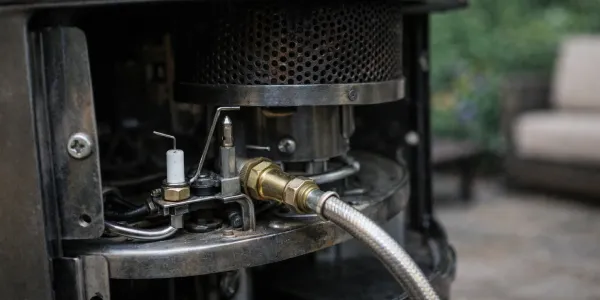
This is one of the most common patio heater problems. Usually, the pilot does light, but it goes out as soon as you release the control knob.
The usual cause is a dirty pilot, a weak pilot flame, or a thermocouple that is not sensing enough heat. The thermocouple is a safety part that shuts the gas off if it thinks the flame has gone out.
Clean the pilot area carefully and make sure you are holding the control long enough during lighting. This is the natural place to link to Pilot Light Goes Out.
If the heater lights but produces very little heat, start by checking the gas level. A low bottle can cause weak and inconsistent flame.
Then inspect the regulator, hose, and burner area. Restricted gas flow or partial blockage can both lead to low output. A dedicated internal link to Low Flame would fit well here.
If the pilot stays on but the main burner never fully comes to life, the issue may be in the burner path or control settings. Dirt, insect nests, and debris can interfere with gas reaching the burner properly.
Check visible openings for blockage, but do not start dismantling gas controls unless you know exactly what you are doing.
If the heater starts normally and then cuts out after a short time, the problem often comes back to flame sensing or unstable burning conditions.
A weak thermocouple signal, a disturbed pilot flame, or poor airflow can all cause the heater to shut itself down. That safety shutdown is there for a reason, so it should never be bypassed.
Related: Why does my patio heater keep shutting off?
Some patio heater repair is not worth guessing at. If you smell gas strongly, hear hissing, notice damaged hose fittings, or see an unusual sooty yellow flame, stop using the heater.
Turn off the gas at the cylinder and do not try to relight it until the cause is clear. At that point, the issue has moved beyond routine troubleshooting.
A lot of people make the job harder by jumping straight to replacement parts without first paying attention to the symptom. A heater that will not click is different from one that clicks but will not light. A heater that lights and dies is different again.
A more careful approach usually gives you a better answer much faster.
Even simple patio heater troubleshooting should be done carefully. These are gas appliances, so it makes sense to stay within basic cleaning and inspection unless you are confident in what you are doing.
If something feels unsafe, it probably is not worth pushing further.
Most recurring faults come from outdoor exposure, dirt buildup, or poor off-season care. A little maintenance goes a long way.
Those simple habits prevent a lot of common patio heater not working issues before they become frustrating.
The most common causes are empty gas, poor regulator connection, igniter failure, a dirty pilot, or a weak thermocouple. The exact symptom usually tells you which area to check first.
This usually happens because the thermocouple is not getting enough heat or the pilot flame is unstable. Dirt, wind, or a worn thermocouple are common causes.
A failed igniter, loose wire, or damaged ignition connection are the usual reasons. If there is no clicking sound at all, the ignition system is the first place to inspect.
Low flame is often caused by low gas, regulator issues, hose restriction, or burner blockage. Wind can also affect visible flame strength, but repeated low output usually points to a supply or burner problem.
Basic checks and cleaning are usually fine. If you suspect a gas leak, damaged controls, or anything unsafe, stop using the heater and get proper help.
Most patio heater problems are easier to diagnose once you stop treating them as one big fault. The real clue is in the symptom: no click, no ignition, weak flame, pilot failure, or shutdown after lighting.
That is why good patio heater troubleshooting starts with the basics. Check gas supply, ignition, pilot behaviour, and burner condition in a sensible order rather than guessing.
Many faults can be solved with simple cleaning and checks. If the signs point to gas leakage or damaged components, the safest fix is to stop there and deal with it properly.




Sign up for free and get the hottest outdoor heater news direct to your inbox, you never know what you goodies you might find